
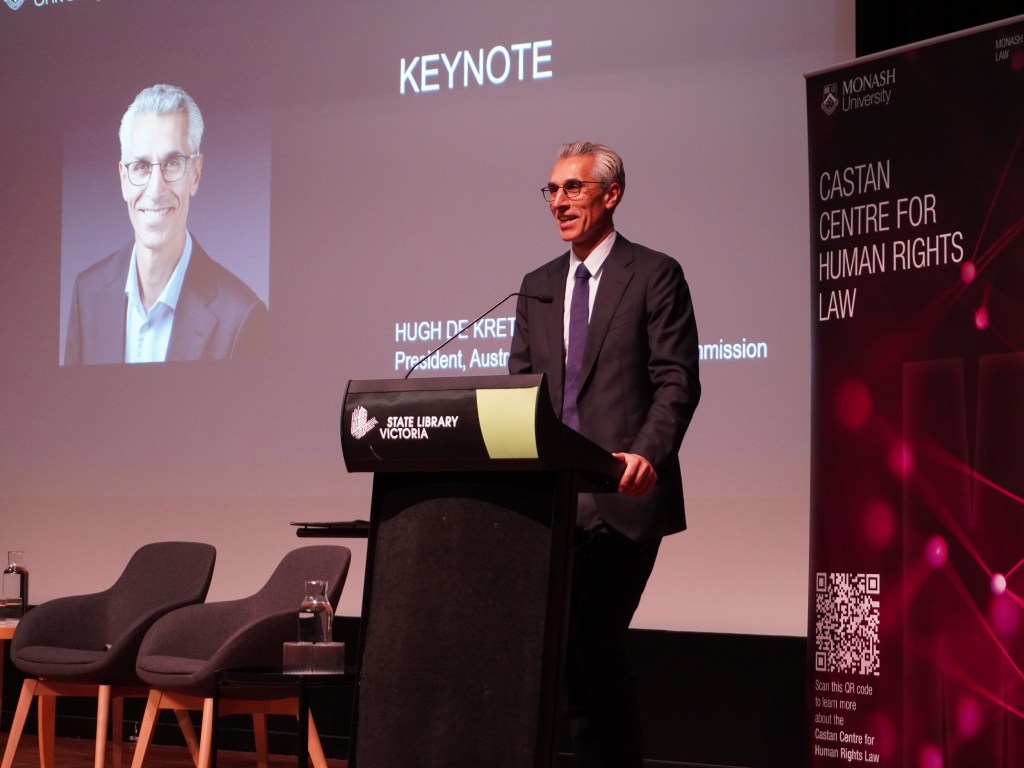
By Hugh de Kretser
This is the third in our series of blogs from the 2025 Annual Castan Centre for Human Rights Law Conference. Highlighting gaps in Australia’s current human rights framework, Hugh de Kretser, President of the Australian Human Rights Commission, presents a bold path toward meaningful protections for all.
You can watch Hugh’s presentation here.
Australia’s human rights record will be scrutinised at the United Nations Human Rights Council in January 2026 in a process known as the Universal Periodic Review. The review happens every 5 years and involves other nations reviewing our human rights record and recommending improvements. Australia is expected to make voluntary commitments to improve human rights as part of the review and respond to the recommendations.
So how are we doing on human rights? We have seen progress on some issues since our last review in 2021. The implementation of the Respect@Work recommendations has seen steps forward in addressing sexual harassment and sex discrimination in workplaces. In particular, employers now have a positive duty to take proactive steps to eliminate sexual harassment and other unlawful conduct. There is progress on some of the Closing the Gap targets including early childhood education, jobs and land rights. States like Victoria and South Australia are making progress on truth telling, treaty and representative bodies for First Peoples. The Albanese Government has committed to improvements to Medicare, housing, childcare and higher education.
But Australia has gone backwards on other issues. Racism has risen after the failed Voice referendum and due to impacts of the war in the Middle East. More First Peoples are being locked up in jails due to harsh, counterproductive criminal justice polices. More First Peoples children are being removed from their families and communities because of failing child protection policies. People who arrive by boat in Australia seeking safety from persecution are still being sent offshore to the tiny island nation of Nauru. Progress on implementing the Uluru Statement from Heart has stalled at the national level and gone backwards in some states like Queensland. The age of criminal responsibility is still 10 in most jurisdictions. This means that children in grade 5 in primary school can be arrested, prosecuted and locked up.
A major focus of the upcoming Universal Periodic Review will be on the lack of an Australian Human Rights Act. While Australia has committed to protect people’s rights under international treaties, we haven’t properly translated those commitments into Australian law. Our human rights protections are patchy and our human rights safety net has holes. This affects people’s lives.
The Australian Human Rights Commission has outlined a plan for improving people’s rights in Australia, including through an Australian Human Rights Act, more effective discrimination laws and improved human rights education. Alongside colleagues in the NGO sector, we are encouraging the Australian Government to commit to reforms like these as part of the Universal Periodic Review process.
Across my career, I’ve seen how positive changes happens. John Kingdon’s concept of “policy windows” helps explain how change occurs. Reform requires three elements to align: a clearly understood problem, a feasible solution and the political will to act. Policy windows open unpredictably. Human rights advocates must build expertise and strong, trusted relationships to seize these opportunities as they arise.
My work with the Victorian Law Reform Commission reinforced the importance of engaging with competing perspectives. If we want government or business to take up human rights reforms, we must understand the perspectives of those who oppose the reforms. We need to address those perspectives. We also need to look for compromise, common ground and consensus to make it easier for government to act.
Human rights are Australian values. Australia can and should lead the world on protecting people’s human rights and ensuring everyone in our nation has the chance to live well. To help achieve this, we need stronger human rights protections. It is time for an Australian Human Rights Act.
Hugh de Kretser is President of the Australian Human Rights Commission. This article is based on his keynote address at the 2025 Annual Castan Centre for Human Rights Law Conference.
 Castan Centre for Human Rights Law
One response to “Windows of Opportunity: Charting Australia’s Human Rights Future”
Excellent article! 👏 Stronger human rights laws are essential to tackle issues like harassment and discrimination — Australia truly needs a Human Rights Act.